

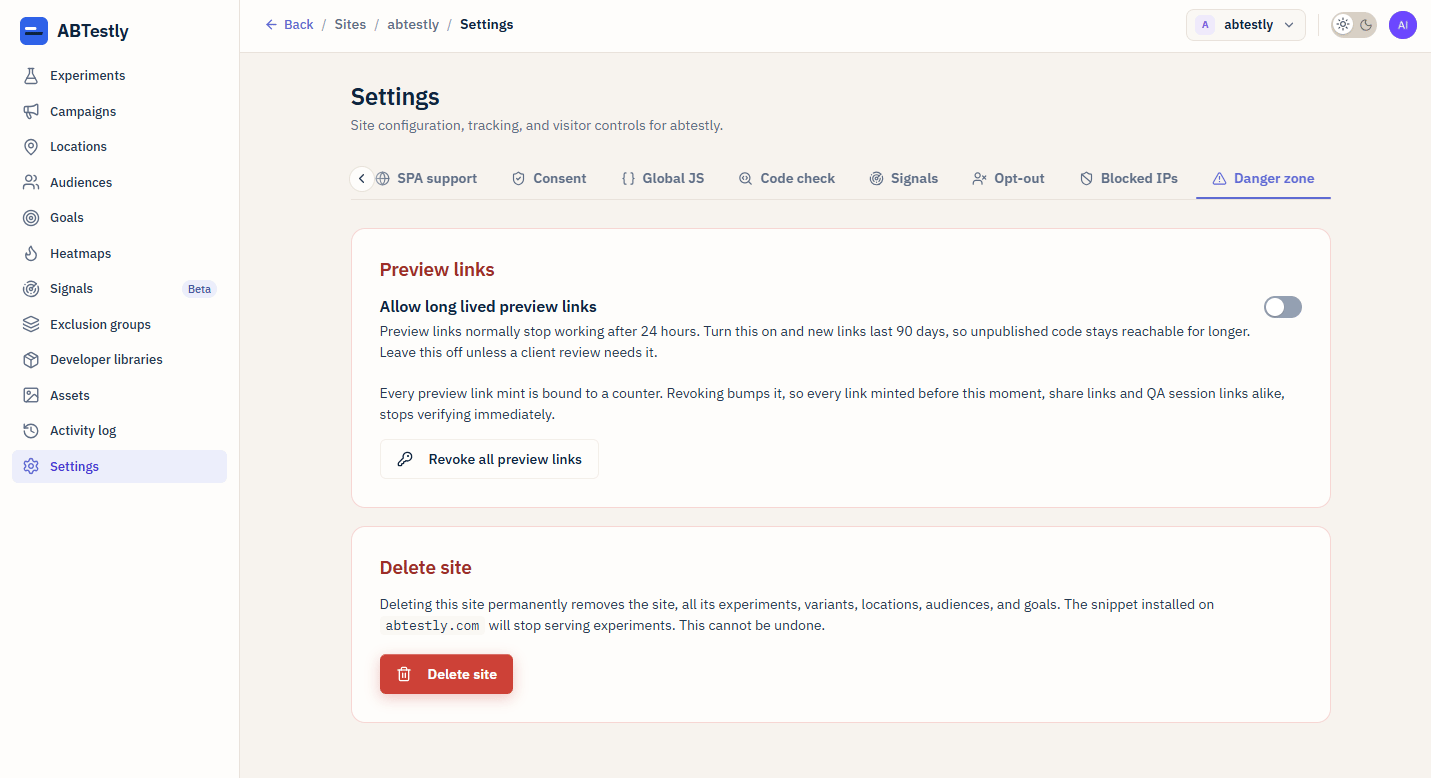
Settings: Danger zone.
Preview links
- Allow long lived preview links. Preview links normally stop working after 24 hours. Turn this on and new links last 90 days, so unpublished code stays reachable for longer. Leave it off unless a client review needs it.
- Revoke all preview links. Every preview link for the site stops working at once, share links and QA session links alike, including ones your team has already shared. You confirm in a dialog first.
Delete site
The Delete site button removes the site and everything on it.What deletion actually does
- Every experiment on the site is deleted. Live, paused, archived, everything.
- Every event in the ledger for this site is purged. Not soft-deleted. Purged.
- Every uploaded asset is scheduled for R2 deletion. Any variant or email referencing the asset URL will 404 within a few minutes.
- Every goal, location, audience, exclusion group is removed.
- The snippet on the site stops being valid. Requests to the snippet URL will return an empty stub. Deployed pages with the snippet will still load; the snippet just does nothing.
What deletion does not do
- Does not remove the site from the workspace’s usage count for the current billing period. MTU already used counts for the month.
- Does not un-invoice a paid plan. For a refund, see Refunds.
The confirmation
Deletion asks you to type the site’s name into a confirmation field, and Delete permanently stays disabled until it matches. That friction is deliberate: muscle memory should not be able to delete a site.No undo
We do not keep hidden backups. When it is deleted, it is deleted.Alternatives to deletion
Before you delete, consider:- Archive the site. Not currently a first-class action, but you can archive every experiment on it and leave the site itself empty. That preserves the historical data and the snippet key.
- Cancel the subscription instead. Your site stays and every running experiment keeps running. At the end of the period the account moves to the Free tier limits, which cap what you can start rather than switch anything off. See Refunds.
- Rename the site. If the reason you want to delete is that the name is wrong or the domain moved, edit the site instead of starting over.