

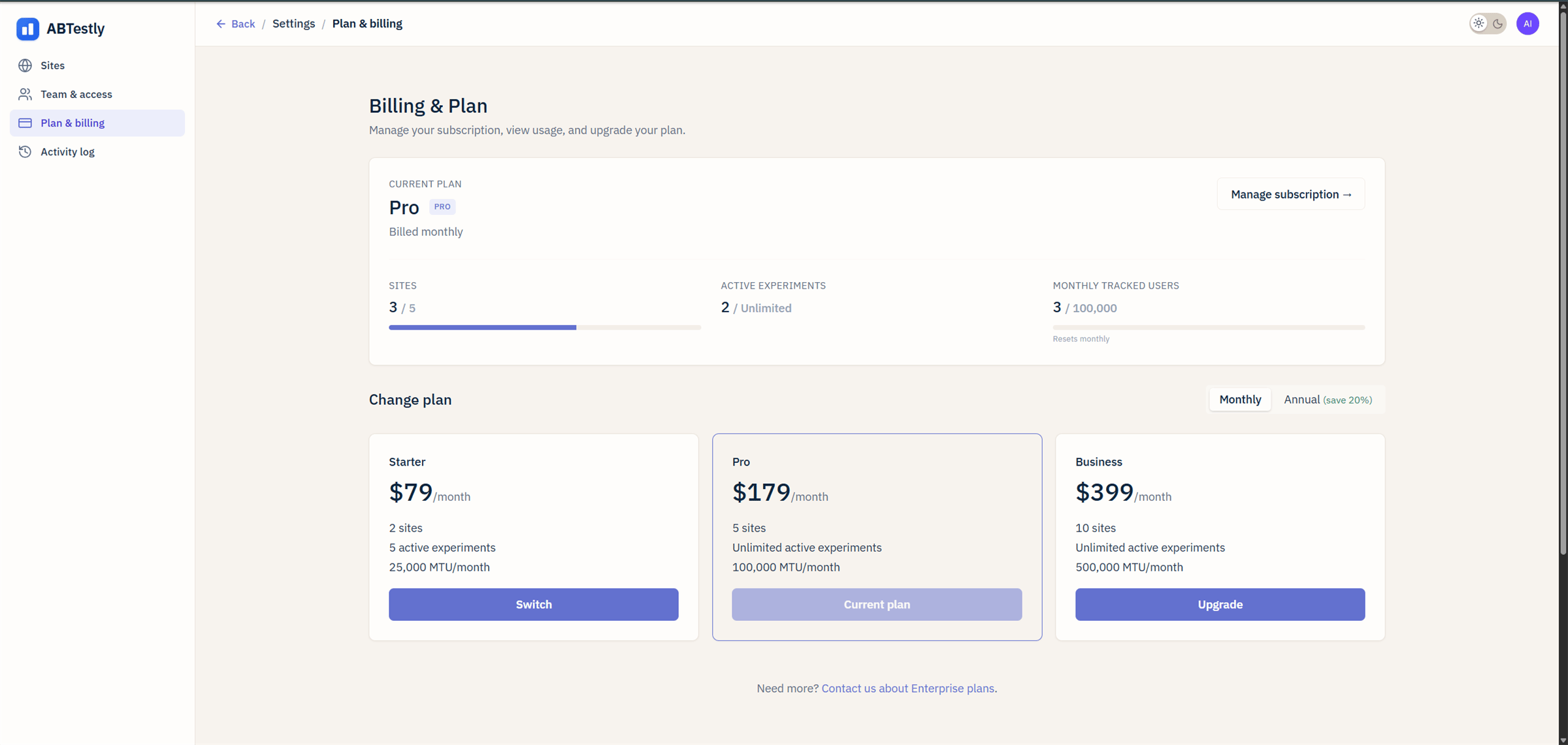
Billing page. Plan, usage against your caps, and the upgrade path.
How it is counted
Every visitor gets a stable id (a UUID in localStorage and a cookie on your site’s eTLD+1). The first time in the month a visitor is bucketed into any experiment, they count as one MTU. Every subsequent bucketing that month, they do not. Counted server-side by hashing the visitor id and checking a Durable Object per organization. There is no client-side gate a misconfigured page can trip; the meter is entirely on our side.What does not count
- A visitor on a page with no experiment. Not counted.
- A visitor who did not enter (allocation < 100 %). Not counted.
- A blocked IP (Settings → Blocked IPs). Dropped before the MTU record is written.
- An opted-out visitor (Visitor opt-out). The snippet never fires.
- Preview mode. Preview does not send real beacons.
MTU across multiple sites
Your allowance is pooled across every site in your account. There is no per site cap, and no per site usage figure. One organization, one meter. How many MTUs a returning visitor uses depends on whether your sites share a domain, because the visitor id lives in that domain’s localStorage and cookie jar:
Subdomains of one registrable domain share a visitor id, so they
share the MTU. Two genuinely different domains cannot: browsers give
each domain its own isolated storage, so the same human arrives as
two unrelated visitors and is metered twice. No cross domain
identifier exists to join them, and adding one is not something we
plan to do.
Different organizations always count separately, because the
organization id is the salt in the hash.
Registering
shop.example.com as a second site alongside
example.com splits one visitor into two and bills you twice for
them. Register the apex domain once. The same snippet covers every
subdomain under it.MTU across the month
Resets at the first of every month UTC. A visitor tracked in January starts fresh in February.Going over
If you exceed your plan’s cap:- Already-bucketed visitors stay bucketed. Their variant does not change. Statistical validity of your running experiments is preserved.
- New visitors stop being bucketed. They see the Original.
- You get an email with a graph of your recent MTU consumption and a link to upgrade.
- You are not auto-charged. The bill does not change on its own.