> ## Documentation Index
> Fetch the complete documentation index at: https://docs.abtestly.com/llms.txt
> Use this file to discover all available pages before exploring further.
# Global JS
> One JavaScript block that runs on every page of the site, before any variant. For shared helpers, polyfills, or one-time analytics wiring.
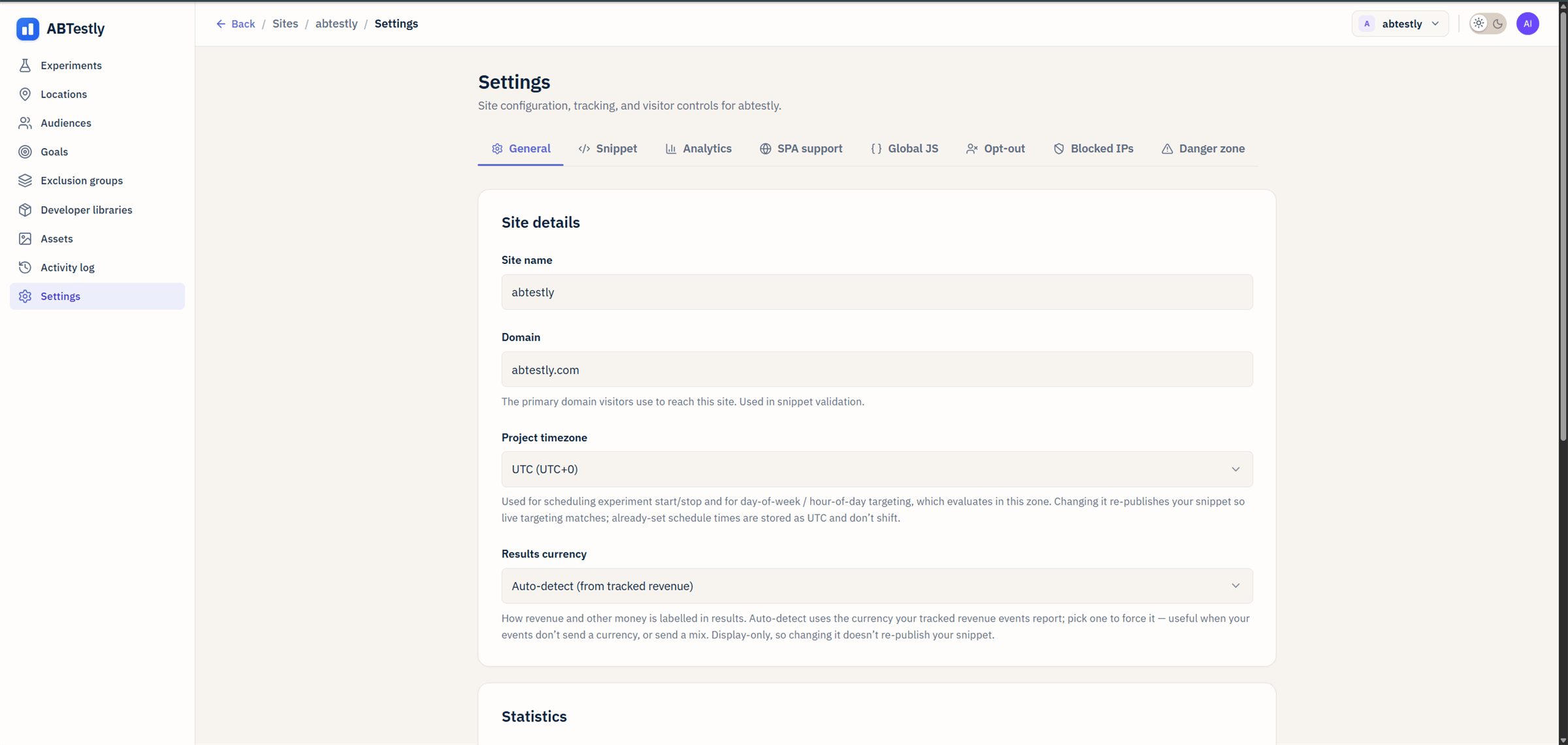
**Site → Settings → Global JS.** Publish-gated (needs the Global JS
permission on this site, which requires Publish).
 ## What it is
A single JavaScript block that runs once per page per visitor,
**before** any variant's code. Useful for:
* **Shared helpers.** A `waitFor` polyfill, a debounce utility, a
branded logger. Instead of copying the same function into every
variant, put it here.
* **One-time analytics wiring.** A GA4 `configure` call, a Segment
identify, something your variants can then use without repeating.
* **Feature flags read from your own system.** Cache your feature flag
values into a global so your variant JS can read them
synchronously.
## When it runs
1. Consent gate has passed (see [Consent](/install/consent)).
2. Visitor is not opted out (see [Opt-out](/install/opt-out)).
3. **Global JS runs.** Once per page. Wrapped in a `try / catch`.
4. The rest of the runtime decides variants and applies them.
Because it runs before any variant, code in Global JS can define
utilities that variant code then uses.
## Once per page per site
`window.__abtestlyGlobalJsRan[siteId]` is set on first run. A second
call, for example on a SPA route change, is a no-op. The block runs
once and stays.
That is deliberate: shared helpers are almost always things you want
to define once. Anything that needs to fire on route change belongs in
[SPA panel](/settings/spa-panel), not here.
## Size cap
**50 KiB UTF-8**. The editor counts bytes and refuses to save over the
cap. Almost every real Global JS is well under this, even a large
utility library gzip-inlined into base64 has room.
## Errors
Errors thrown inside Global JS are caught, logged to the browser
console with a prefixed message, and reported to ABTestly via the
`/err` beacon (first-occurrence-per-session, deduped).
An error in Global JS does **not** stop variant JS from running. It
does mean whatever your Global JS was supposed to provide is not
available to variants; if variants blindly assume it worked, they will
throw too.
Wrap risky code in try/catch inside Global JS and fall back gracefully.
## Example
```js theme={null}
// site-wide helper: a small debounce
window.__ab = window.__ab || {};
window.__ab.debounce = function (fn, ms) {
let t;
return function () {
clearTimeout(t);
t = setTimeout(() => fn.apply(this, arguments), ms);
};
};
// site-wide config
window.__ab.cfg = {
brandName: 'Acme',
isPro: /pro=1/.test(location.search),
};
```
Variants can then:
```js theme={null}
window.__ab.debounce(track, 200)();
if (window.__ab.cfg.isPro) { … }
```
## What Global JS is *not* for
* **Variant code.** If it belongs to a specific experiment, put it in
the variant. Global JS is site-wide, always-on. A "test" living in
Global JS is not a test.
* **Anything with heavy DOM manipulation.** DOM changes belong in
variants where they can be scoped and cleaned up on SPA
route change.
* **Third-party script loading.** Load third parties from your own
`
## What it is
A single JavaScript block that runs once per page per visitor,
**before** any variant's code. Useful for:
* **Shared helpers.** A `waitFor` polyfill, a debounce utility, a
branded logger. Instead of copying the same function into every
variant, put it here.
* **One-time analytics wiring.** A GA4 `configure` call, a Segment
identify, something your variants can then use without repeating.
* **Feature flags read from your own system.** Cache your feature flag
values into a global so your variant JS can read them
synchronously.
## When it runs
1. Consent gate has passed (see [Consent](/install/consent)).
2. Visitor is not opted out (see [Opt-out](/install/opt-out)).
3. **Global JS runs.** Once per page. Wrapped in a `try / catch`.
4. The rest of the runtime decides variants and applies them.
Because it runs before any variant, code in Global JS can define
utilities that variant code then uses.
## Once per page per site
`window.__abtestlyGlobalJsRan[siteId]` is set on first run. A second
call, for example on a SPA route change, is a no-op. The block runs
once and stays.
That is deliberate: shared helpers are almost always things you want
to define once. Anything that needs to fire on route change belongs in
[SPA panel](/settings/spa-panel), not here.
## Size cap
**50 KiB UTF-8**. The editor counts bytes and refuses to save over the
cap. Almost every real Global JS is well under this, even a large
utility library gzip-inlined into base64 has room.
## Errors
Errors thrown inside Global JS are caught, logged to the browser
console with a prefixed message, and reported to ABTestly via the
`/err` beacon (first-occurrence-per-session, deduped).
An error in Global JS does **not** stop variant JS from running. It
does mean whatever your Global JS was supposed to provide is not
available to variants; if variants blindly assume it worked, they will
throw too.
Wrap risky code in try/catch inside Global JS and fall back gracefully.
## Example
```js theme={null}
// site-wide helper: a small debounce
window.__ab = window.__ab || {};
window.__ab.debounce = function (fn, ms) {
let t;
return function () {
clearTimeout(t);
t = setTimeout(() => fn.apply(this, arguments), ms);
};
};
// site-wide config
window.__ab.cfg = {
brandName: 'Acme',
isPro: /pro=1/.test(location.search),
};
```
Variants can then:
```js theme={null}
window.__ab.debounce(track, 200)();
if (window.__ab.cfg.isPro) { … }
```
## What Global JS is *not* for
* **Variant code.** If it belongs to a specific experiment, put it in
the variant. Global JS is site-wide, always-on. A "test" living in
Global JS is not a test.
* **Anything with heavy DOM manipulation.** DOM changes belong in
variants where they can be scoped and cleaned up on SPA
route change.
* **Third-party script loading.** Load third parties from your own
`