> ## Documentation Index
> Fetch the complete documentation index at: https://docs.abtestly.com/llms.txt
> Use this file to discover all available pages before exploring further.
# General settings
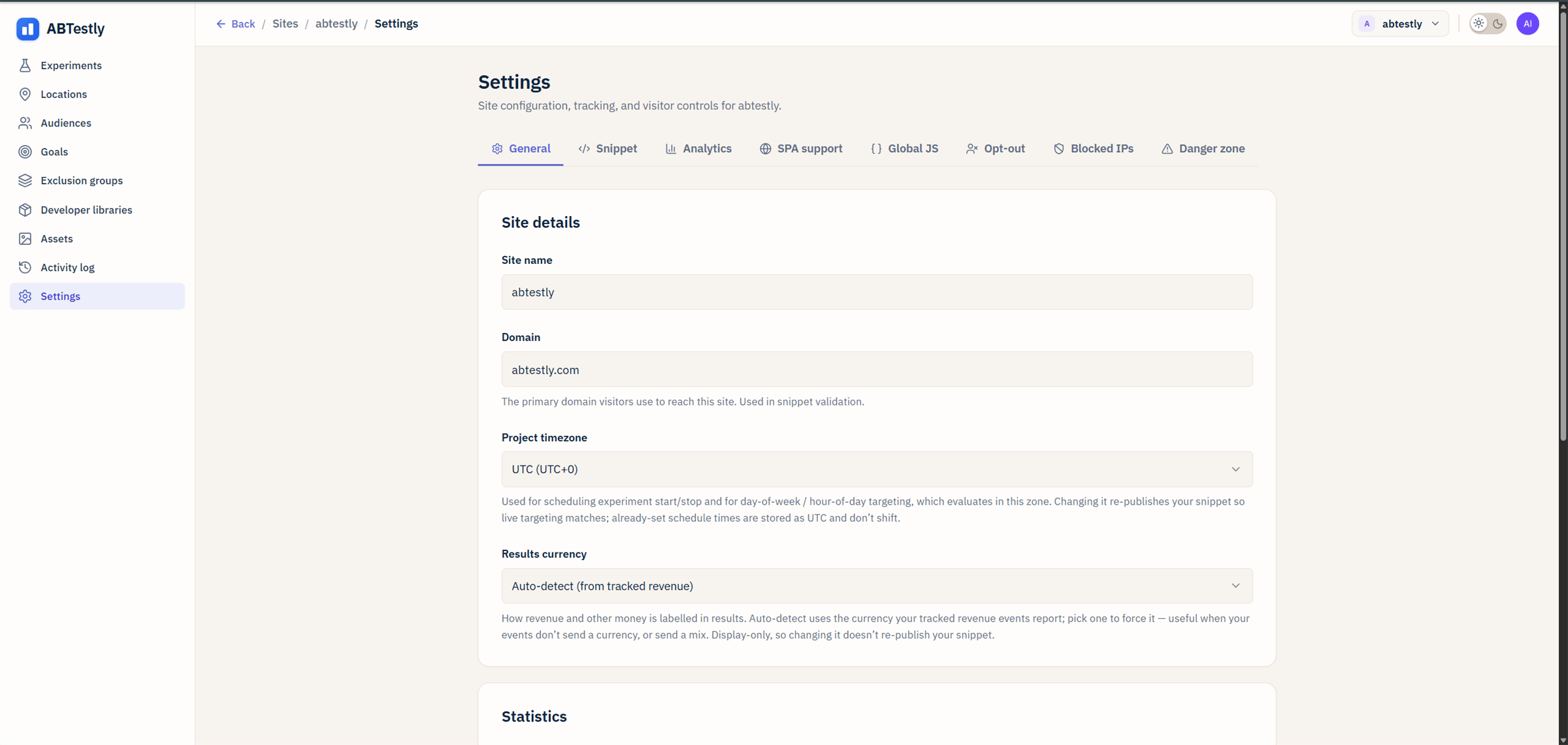
> The site-wide knobs. Name, domain, project timezone, currency, default statistics engine.
Everything that applies to every experiment on the site lives here.
**Site → Settings → General.** Admin-only page.
 ## Site name
The human name used in the dashboard, the sites list, and outbound
emails. Change it any time; it does not affect any URL or the snippet.
## Domain
The registered domain the site's snippet is keyed to. Cannot be edited
in place, if you need to move a site to a different domain, add a new
site and install a fresh snippet there.
## Project timezone
The one setting that quietly powers a lot of things:
* Day-of-week and hour-of-day audience rules.
* The clock the [scheduler](/build/schedule) reads for start and end
times.
* The date range picker on the results page.
* Timestamps in the [activity log](/team/activity-log).
Grouped by region with UTC offset in the picker. Set once, per site.
Changing it does not retroactively change collected data, timestamps
already stored stay as they were.
## Currency
Reporting currency for revenue metrics on this site. Auto-detected from
your workspace on first setup; adjustable to any ISO currency.
ABTestly does not do currency conversion. If your goals fire with
values in multiple currencies, convert to one currency in your own
code before firing. See [revenue metrics](/results/revenue-metrics).
## Default statistics engine
Every new experiment on this site starts with this engine picked. Each
experiment can override it in the editor.
Options:
* **Frequentist** (`freq-z-1`)
* **Sequential** (`seq-bern-betamix-union-1`)
* **Bayesian** (`bayes-beta-1`)
See [the engines page](/results/engines) for how to pick.
## Default confidence level
The threshold the primary verdict uses to call a winner. Standard
values: 90 %, 95 % (default), 99 %. Only applies to frequentist and
sequential engines, Bayesian reports probability directly and does
not have a "threshold" concept.
## Multiplicity correction
Whether the results page adjusts confidence when the experiment has
more than one goal. Options:
* **None**, raw p-values per goal, no adjustment.
* **Bonferroni**, divide the threshold by the number of goals. Simple
and conservative.
* **Benjamini–Hochberg**, controls false discovery rate. Better power
than Bonferroni for tests with several goals.
Default: **None** for one primary + auto guardrails. Bonferroni is a
reasonable pick if your tests routinely have 3 or more primary-level
goals.
## What does not live here
* Snippet code and anti-flicker, under [Settings → Snippet](/settings/snippet-panel).
* SPA route detection, under [Settings → SPA support](/settings/spa-panel).
* Analytics dataLayer fan-out, under
[Settings → Analytics](/settings/analytics-adapters).
* Global JavaScript that runs on every page, under
[Settings → Global JS](/settings/global-js).
* The opt-out URL you share with visitors, under
[Settings → Opt-out](/install/opt-out).
* Blocked IPs, under [Settings → Blocked IPs](/settings/blocked-ips).
* Delete the site, under [Settings → Danger zone](/settings/danger-zone).
## Site name
The human name used in the dashboard, the sites list, and outbound
emails. Change it any time; it does not affect any URL or the snippet.
## Domain
The registered domain the site's snippet is keyed to. Cannot be edited
in place, if you need to move a site to a different domain, add a new
site and install a fresh snippet there.
## Project timezone
The one setting that quietly powers a lot of things:
* Day-of-week and hour-of-day audience rules.
* The clock the [scheduler](/build/schedule) reads for start and end
times.
* The date range picker on the results page.
* Timestamps in the [activity log](/team/activity-log).
Grouped by region with UTC offset in the picker. Set once, per site.
Changing it does not retroactively change collected data, timestamps
already stored stay as they were.
## Currency
Reporting currency for revenue metrics on this site. Auto-detected from
your workspace on first setup; adjustable to any ISO currency.
ABTestly does not do currency conversion. If your goals fire with
values in multiple currencies, convert to one currency in your own
code before firing. See [revenue metrics](/results/revenue-metrics).
## Default statistics engine
Every new experiment on this site starts with this engine picked. Each
experiment can override it in the editor.
Options:
* **Frequentist** (`freq-z-1`)
* **Sequential** (`seq-bern-betamix-union-1`)
* **Bayesian** (`bayes-beta-1`)
See [the engines page](/results/engines) for how to pick.
## Default confidence level
The threshold the primary verdict uses to call a winner. Standard
values: 90 %, 95 % (default), 99 %. Only applies to frequentist and
sequential engines, Bayesian reports probability directly and does
not have a "threshold" concept.
## Multiplicity correction
Whether the results page adjusts confidence when the experiment has
more than one goal. Options:
* **None**, raw p-values per goal, no adjustment.
* **Bonferroni**, divide the threshold by the number of goals. Simple
and conservative.
* **Benjamini–Hochberg**, controls false discovery rate. Better power
than Bonferroni for tests with several goals.
Default: **None** for one primary + auto guardrails. Bonferroni is a
reasonable pick if your tests routinely have 3 or more primary-level
goals.
## What does not live here
* Snippet code and anti-flicker, under [Settings → Snippet](/settings/snippet-panel).
* SPA route detection, under [Settings → SPA support](/settings/spa-panel).
* Analytics dataLayer fan-out, under
[Settings → Analytics](/settings/analytics-adapters).
* Global JavaScript that runs on every page, under
[Settings → Global JS](/settings/global-js).
* The opt-out URL you share with visitors, under
[Settings → Opt-out](/install/opt-out).
* Blocked IPs, under [Settings → Blocked IPs](/settings/blocked-ips).
* Delete the site, under [Settings → Danger zone](/settings/danger-zone).